 Loading... Please wait...
Free Info - Dictation Recorder
How To Choose A Digital Recorder For Your Work
Posted on 15th Sep 2015
How To Choose A Digital Recorder For Your Work?
There are a great number of recorders out there and it can be overwhelming! We'll try to break it down for you to make it as easy to understand as possible. First, digital recorders are broken into 2 main categories: Digital Recorders and Conference Recorders.
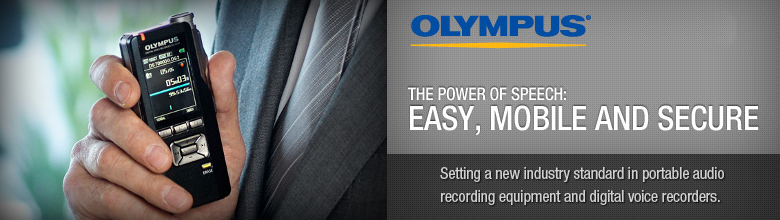
Digital Recorders are primarily used for those in an office environment, who dictate notes, patients' records, etc.: anything where persons will be holding the recorder close to the mouth, and using on a daily or semi-daily basis. These recorders for the most part will have a built-in mono microphone, and editing features, including review, insert, append (attach/add) and delete. They will also have several file folders into which to record, so they can keep track of each day's dictations.
Some voice recorders will also have removable memory. This is handy when you are traveling and run out of space; you can simply insert a new memory card, and you're good to go. You can also purchase a larger memory card, and increase the recording time on the device.
There are many other features included when purchasing a dictation recorder; however, it depends on he brand, price range, etc. Some of these features may include rechargeable batteries, slide switch or push-button thumb operation, hands-free recording, indexing capability and so on. There are also many accessories, such as headsets, tie clip microphones and foot controls that can be used as well. Please call us at 310.475.0859 if you have additional questions on a specific model or brand, and we will do our best to assist or visit our website at www.ReesElectronics.com
Conference Recorders will sometimes come with various recording modes as well, such as STXQ, STHQ, SP, LP, and HQ. It is recommended that you use Olympus DM-620, for example, to create a higher quality (HQ mode) recording in a noisier or larger setting; this will insure that you have a better, clearer recording then you would using a lower quality setting. Also, the higher the quality in which you record, the more space it takes up on your memory card, which reduces the hours you can record.
For instance, if you have a recorder that has 256MB of memory and you are in a room by yourself capturing quick notes, you can use a low quality recording, or LP mode, which will give you about 67 hours of total recording time. Now, if you step into a noisy environment where there are several people talking, perhaps a loud AC unit, etc., you'll want to be sure you record in high quality, or STXQ mode. By doing this, you will have about 4 hours of total recording time. See the difference? It's pretty significant! (It is important to note that conference recorders do not have editing features, and are therefore not recommended as a dictation recorder for someone who needs to dictate letters and notes. There are no rewind/record over features on these units.)
Second, this brings us to our next important feature of conference recorders, which is the memory. As you can see from the scenario above, removable memory is favorable to those who record in noisy environment for long periods of time. This enables you either to use a very large memory card, or add a new one which the first one runs out of space. Similar to voice recorders, if you do most of your recording in the office, or near your computer, you are always able to “dump” the cards when they fill up, and start back from square one.
Rees Electronics - 2140 Westwood Blvd, #224, Los Angeles, CA 90025
Tel: 310.475.0859
www.ReesElectronics.com